 axmc
Why the biggest holder loses anyway
No single wallet can buy an answer on axmc. Each identity's weight is capped at 5% before anything is counted, and changing an answer takes two thirds.
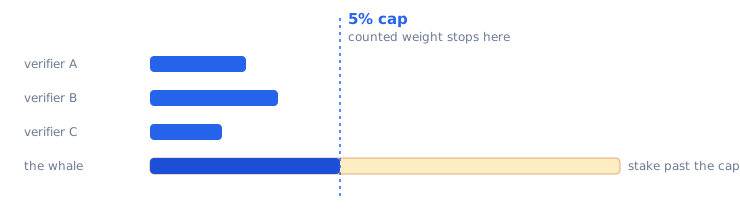
Stake past the cap buys nothing. The whale above holds more than the other three together, yet counts for less than twice any one of them. To overturn an answer it would still need two thirds of the whole assembly to agree, and no single identity can get there alone.
Three numbers
| 5% | the most weight one identity can carry |
| 2/3 | of the seats, or of the counted weight, to decide or overturn an answer |
| 2 | sampled panels between a dispute and a final answer: Round 1, then a grand panel of 15 fresh jurors |
Where the cap applies
The cap is enforced in two places, and in both it is what holds.
- When a panel is drawn. Your odds of a seat follow the square root of your stake, which flattens a big holder's odds. On its own, the square root does not limit how many seats a big holder can win. The 5% cap on each identity's share of the pool does.
- When the assembly counts. The assembly hears corrections to settled answers. It does not use a square root at all. Each identity's weight is cut to 5% before the vote, against a threshold of two thirds.
What about splitting into many wallets?
That does not work either. The square root alone would not stop it: nine wallets holding a ninth each weigh about three times as much as one wallet holding it all. What stops it is the cap together with the ladder. A dispute goes to Round 1, then to a grand panel of 15 jurors who did not sit on Round 1. An attacker has to win a two-thirds majority at each step, and the odds against that multiply.
What the simulation shows
- One identity holding half of all stake was drawn into a winning majority on none of 2,000 first panels. To overturn an answer in the assembly, it would need twice the weight the honest voters bring.
- 30% of stake split across 20 wallets won 0.2% of first panels and never a grand panel.
These runs are Whale buys stake before a vote and Sybil splits stake across wallets in the economics. The ladder itself is in the specification.
What is left over
A patient actor with many high-reputation wallets could hold several capped blocks. It is slow, expensive and public, and the correction window is the backstop. The threat model covers this and the other attacks on the answer.
The 5% cap is a parameter that governance sets. 5% is the default, and every number on this page assumes it.
Source: docs/WHY_THE_BIGGEST_HOLDER_LOSES.md in the axmc repo. Edit the file; the next deploy rebuilds this page.