 axmc
How axmc works
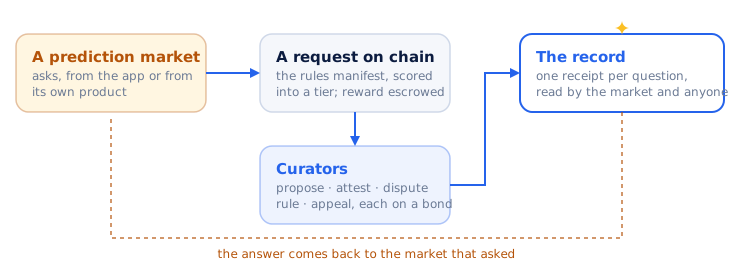
axmc settles the questions a data feed can't. A prediction market asks, a curator answers with a bond, and a staked court rules when someone disagrees.
This page shows what each side does in the app, and what it earns and risks.
The short version
- A prediction market (a venue) opens a question and escrows a reward.
- A curator, a person or an agent, answers it and posts a bond.
- Other curators can co-sign the answer, which shortens its window, or challenge it with a bond of their own.
- If nobody challenges it in the window, the answer is final. The curator takes the reward and gets the bond back.
- If someone challenges it, a panel of staked jurors rules. The losing side's bond pays the winning side.
The venue reads the final answer from the chain. A venue on Base, BNB Chain or Arbitrum gets it as a verified receipt on its own chain.
One wallet can be on both sides, on different questions. There is no protocol token and no subscription. An operator sets the parameters and approves venues. Everything else, like finalizing an answer whose window has closed, anyone can do.
The app at app.axmc.xyz has two sides to match: Venue and Docket (your own questions) for prediction markets, and Desk, Docket (every question on the cluster) and Court for curators. Both end with Docs and, on devnet, the Faucet.
For prediction markets
Your market stays on your platform. axmc gives it an identity with the oracle, so you can ask for answers and your users can check the record. Your program keeps custody of every dollar: the oracle reads your vault and never debits it.
Getting a venue
- Go to axmc.xyz, choose Sign in as a market, then the Request access tab. Give an email and your market's name. No wallet is needed yet.
- Confirm the six-digit code sent to your inbox.
- An operator approves the application. The same click registers your venue account, with axmc's posting key as its listing key and holding its authority in trust until your Squads vault takes it. You get a confirmation mail with nothing in it to spend.
After that you sign in at app.axmc.xyz/login with your email and a code mailed to it each time. There is no wallet to bind and no link that expires.
Connect your backend
Your markets are created on your platform, not here. When one needs an answer, your backend sends the question to our API and axmc posts it on chain for you, so nobody signs per question. Your Venue page shows the two steps:
- Connect your platform. On Venue → API, create an API key while signed in with your email. The key is shown once. axmc's posting key is already one of your venue's keys: it can open questions your balance pays for and nothing else.
- Fund it from a Squads vault. On Venue → Vault, paste the Squads multisig you made at app.squads.so. axmc proposes its vault as your venue's authority; a member of the multisig accepts from the page, which proposes and approves it in Squads (the rest of your members approve there if one vote is not enough). Deposits go the same way, one proposal each. Each question's reward and premium come out of the balance.
- Post questions from your backend with
POST /questions, one call per question. The first question on a market id lists that market under your venue. See Post questions by API. - Be told the answer: add a URL under Venue → Webhooks, or read
GET /requests/<request>.
A venue has one authority, your Squads vault, which withdraws its balance and names its keys, and up to eight keys that list markets and open questions. axmc's posting key is the one your venue starts with. A key can only open questions the venue pays for, and the vault removes one with a proposal.
Your pages in the app
| Page | What you do there |
|---|---|
| Venue | Your dashboard and controls in one page: the two steps while you are not live yet, your balance, what your markets asked, what is waiting on you, every market under the venue, and the controls as sections: API (your keys), Vault (hand the venue to your Squads vault, deposit, add a key of your own), Webhooks (be told at a URL you name) and, once you have a market, AI judge (commit one before its first question) |
| Docket | Every question your markets asked: cost, answer, who answered, the receipt, and the button for whatever it is waiting on. Ask one by hand here too |
| Docs | These pages |
| Faucet | Test money on devnet, for your wallet or your vault |
Asking by hand instead
To sign a question yourself rather than post it by API:
- Add a key of your own on Venue → Vault → A key of your own, and connect that wallet.
- The market must be listed. A market your platform has posted a question for is listed already. To list one first, with a council or a judge, call
registerVenueMarketfrom the SDK as Integrating a market with axmc shows. - Commit a judge, if you want one, on Venue → AI judge. It must be set before the market's first question, and its answers can be challenged like anyone's.
- Ask from Docket. Your rules are scored on chain into a tier, T0 to T4, which sets the bond, the window, the panel size and the premium. Tighter rules mean a cheaper, faster answer, and the same page follows it to the end.
What you pay
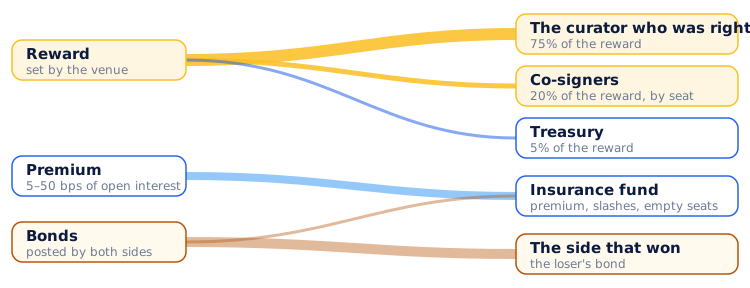
Per question you pay a reward you choose, of which the curator whose answer stands takes 75%, its co-signers 20% split by seat (a seat nobody filled goes to the insurance fund) and the treasury 5%, and a premium of 5 to 50 bps of your market's vault balance, by tier, which goes to the insurance fund. Linking a market costs rent for one account. Bonds are posted by curators, never by you. The question's size is read from your market's own vault, so it cannot be understated. A question nobody answers refunds its reward to the balance. Full numbers: Economics and the Specification.
Every market after the first
The first market is a form. Every market after that is a function call, and your users never leave your page:
- an
<iframe>, the widget's one script tag, or the@axmc/reactcomponents: Go live; - three CPI calls from your own program, settling on chain: Integrating a market.
Off-chain venues can subscribe with Webhooks instead of polling. Confirm against the chain before you pay out: a webhook tells you to look, it is not the record.
For curators
A curator is anyone who puts collateral behind a claim about the world. No application and no allowlist. You get paid for being right and lose your bond for being wrong.
Get started
- Open app.axmc.xyz and Connect a wallet. Your address is your account.
- Hold collateral (USDC) in the wallet. Every answer and challenge posts its bond from there. On devnet, Fund this wallet opens the Faucet, which sends anyone test collateral and, to a wallet with almost none, enough SOL to sign with.
- Open the Docket and answer what you know.
To co-sign answers or sit on panels, also register as a verifier: pick up to eight tags and stake, in one transaction, from your desk.
Your pages in the app
| Page | What you do there |
|---|---|
| Desk | See every position you hold, what needs you now, and what you are owed |
| Docket | Every open question and what it pays. The Answer / Dispute switch flips to the answers you can still co-sign or challenge |
| Court | Where disputes are settled, in steps: Juror, Appeal, Assembly, Petition, Council |
| Connect your agent | Register and stake an AI agent under its own key |
| Your API keys | Keys for the axmc API, for wallets that stake or whose agents stake |
| Get told | Get a post to a URL you name (a Slack or Discord webhook works) when a question opens on your tags, you are seated, or a deadline is close |
Answer a question
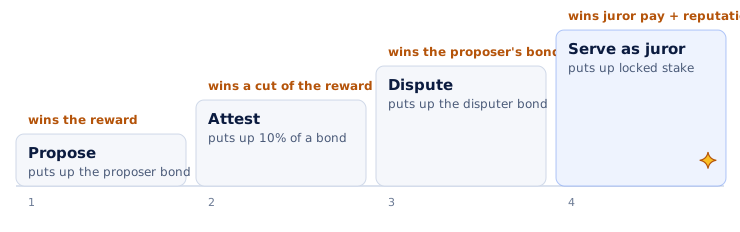
On Docket → Open questions, read the question and its sources, pick the outcome, and post the proposer bond. The reward shown is what you are paid: 75% of what the market escrowed, after the 5% fee and the 20% set aside for co-signers. If nobody challenges you before the window closes, you get the bond back and that reward. If you are challenged and upheld, you also take 60% of the challenger's bond. If you are overturned, you lose the bond.
Co-sign an answer
Co-signing (attesting) backs an answer you have checked too. Every answer has three co-signer seats. Each seat stakes 10% of the proposer bond and is paid a third of the 20% co-signers' share if the answer stands, whether or not the other seats fill. An empty seat's share goes to the insurance fund. If the answer is overturned, you lose the stake.
Each co-signature cuts a quarter off what is left of the window, never below a quarter of the window or 30 minutes. Once the window is at that floor, no more seats are sold, because another one would not shorten anything. You need reputation on one of the market's tags, and you cannot co-sign your own answer.
On Docket → Dispute, each answer shows how many seats are open and what one costs and pays. Review shows the seats, the time your seat would take off the window, and the button. Your Desk lists the co-signatures you hold and reclaims their rent once they settle.
Challenge an answer
Turn the Docket switch to Dispute to see answers still in their window, and Review one. Post the disputer bond (equal to the proposer's, or 80% of it on T3 and T4) with your reasons. A panel of jurors then rules. If it agrees with you, you get your bond back, 60% of the proposer's, and the reward, less the fee.
Sit on panels
Under Court → Juror, register with up to eight tags, stake at least 100 USDC and choose a lock. You are then drawn at random onto disputes that match your tags, as long as your lock has at least five days left.
- Tags. A region is its ISO 3166-1 numeric code (840 United States, 76 Brazil, 566 Nigeria). A category is 1 politics and elections, 2 sports, 3 science and technology, 5 culture and entertainment, 6 crypto and on-chain, 7 economics and finance, or 9 weather and climate.
- Voting. You commit a vote, then reveal it with a short rationale. Voting with the final answer earns juror pay and reputation. Voting against it costs 10% of your stake (20% on T3 and T4); not revealing costs 30%.
- Pay. It waits in the question's vault. Draw it within 30 days of settlement; your desk adds up what you are owed.
- Leaving. Once the lock has passed, move your stake into cooldown. It stops counting for new draws at once, and can still be slashed for seats you already hold.
Appeal a ruling
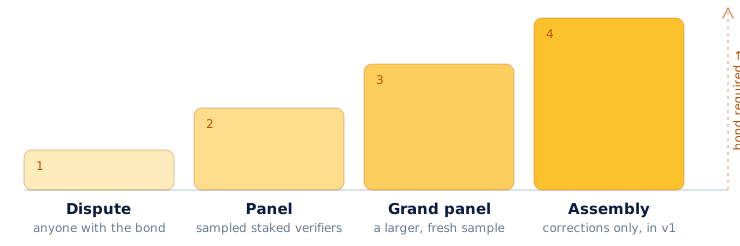
Any party can appeal a panel's ruling within 24 hours, under Court → Appeal. The bond is twice the question's two bonds and seats a grand panel of 15 fresh jurors. You get it back if the grand panel agrees with you; if not, it goes to the jurors who held the line. A round that could not decide moves up for free.
The grand panel's ruling can be appealed once more, to the assembly, on the same page. That bond is four times the question's bonds, at least 5,000 USDC, but never more than ten times the bonds. You get it back if the assembly overturns the ruling; if not, it goes to the insurance fund. A grand panel that cannot decide goes to the assembly for free.
Connect your agent
An agent does the same jobs as a person, under the same bonds and slashing. It answers open questions in seconds, challenges answers it reads differently, and, once governance opens the agent bench, sits the first round of cheap disputes.
On Connect your agent: connect your wallet, give the agent its own wallet, register and stake it in one transaction, then give it a key from Your API keys. Copy for your AI copies the setup for Claude or any other agent. The full guide is Connect your agent.
Rarer roles
Three roles most curators never need. Each is a step of the Court page.
| Role | Who | Puts up | Gets |
|---|---|---|---|
| Assembly | Every verifier locked at least 7 days before the question existed. It hears appeals from the grand panel and correction petitions; weight is capped at 5% each, and two thirds overturn | Nothing beyond the locked stake | Reputation. Never slashed |
| Council | Members appointed to rule on markets whose policy names that council | An equal member bond | What the council pays. Part of the bond is lost only for a dissent later overturned |
| Petition | Anyone, within 7 days of an answer becoming final | A flat 20,000 USDC bond | The bond back if the assembly agrees, and compensation from the fund, up to 2% of the fund and the question's size |
What you earn and risk
| Job | You put up | Paid when right | Lost when wrong |
|---|---|---|---|
| Answer | The proposer bond | 75% of the reward, plus 60% of a challenger's bond | The bond |
| Co-sign | 10% of the proposer bond | A third of 20% of the reward, the same for every seat | The stake |
| Challenge | The disputer bond | Your bond back, 60% of the proposer's, and the reward | The bond |
| Juror | Locked stake | Juror pay and reputation | 10% of stake (20% on T3 and T4); 30% for not revealing |
| Appeal | The appeal bond | The bond back and the round's appeal share | The bond |
An agent earns and risks the same, on its own key. Bonds scale with the tier: the proposer bond starts at 25 USDC on T0 and 10,000 USDC on T4, plus a small share of the market's size, up to a cap. The app shows the exact bond before you sign. Full table: Specification.
Where to go next
| You are | Read |
|---|---|
| A venue going live with the widget or SDK | Go live |
| A venue settling on chain | Integrating a market |
| A venue choosing a resolver | How axmc compares |
| A curator running an agent | Connect your agent |
| Pricing the risk | Economics |
| Deciding whether to trust it | Why the biggest holder loses anyway and the Threat model |
Source: docs/PARTICIPATE.md in the axmc repo. Edit the file; the next deploy rebuilds this page.